
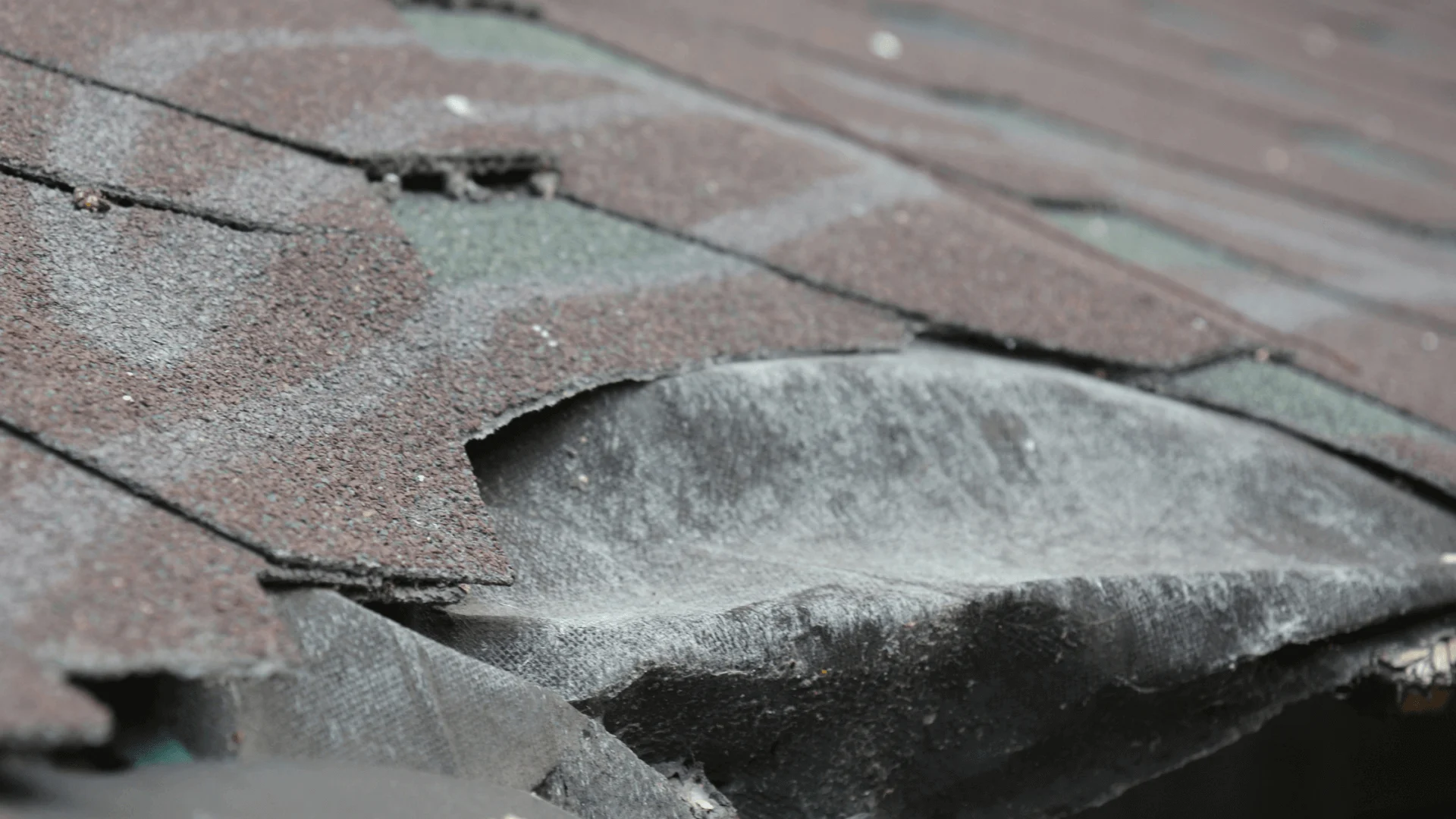
Open, flat terrain gives North Dakota's windstorms nothing to slow them down before they reach a commercial roof. Straight-line winds ahead of a summer thunderstorm line, and the occasional derecho pushing across the plains, can generate uplift forces strong enough to peel membrane at the perimeter, tear edge metal loose, and shift rooftop equipment on its curb, often with no hail involved at all.
Wind damage claims are frequently underscoped because the evidence is subtler than a hail claim's dents and bruising. A membrane that was lifted and re-seated by wind can look intact from a quick walk while the seams and fasteners underneath have already been compromised. We evaluate roof attachment and seam integrity across the full field, including areas beyond where a leak has already shown up.
How Wind Damages a Flat Commercial Roof
Wind uplift concentrates at roof corners and perimeters, which is exactly where edge metal, coping, and membrane termination bars take the most load. We check those zones first, then work inward, documenting lifted or billowed membrane, torn seams, and any section where the attachment pattern shows signs of having released and re-seated under load. On mechanically attached systems we look closely at fastener spacing and back-out; on adhered systems we check for bond failure at seams and perimeter.
Rooftop Equipment and Edge Conditions
Rooftop units, exhaust fans, and satellite or antenna mounts common on office, medical, and institutional buildings around Fargo and Bismarck can shift on their curbs or tear loose entirely in a strong wind event, sometimes damaging duct connections or curb flashing in the process. We inspect and document every piece of rooftop equipment as part of a wind claim, since equipment damage is one of the most commonly overlooked items in a fast adjuster scope.
Large-Span Roofs in Open Terrain
Grain-handling and ag-processing facilities near Fargo and Grand Forks, and industrial and warehouse buildings tied to western North Dakota's Bakken-adjacent activity, often sit on wide open ground with little windbreak, and their large, uninterrupted roof spans can take wind uplift across a much bigger area than a smaller commercial building. We walk the full perimeter and interior field on these roofs rather than sampling a section, since wind damage on a large-span roof does not always concentrate in one predictable spot.
Why Wind Claims Need Careful Documentation
Because a wind event does not always leave the obvious visual signature that hail does, we lean on photo documentation, seam and fastener checks, and, where the extent is unclear, test cuts to confirm whether membrane attachment has actually been compromised. That level of detail is what separates a wind claim that gets a fair scope from one that gets written off as cosmetic.
Working the Claim With Your Adjuster
Once we have documented the roof, we meet the adjuster on-site and walk the same conditions we recorded, pointing out perimeter and corner damage, equipment displacement, and any stressed seams that might not be visible on a quick pass. We're your roofing contractor, not a public adjuster, we document and substantiate the roof damage so you and your adjuster work from an accurate scope.
If a windstorm or thunderstorm line moved through your area recently, a roof-level inspection can confirm whether membrane, edge metal, or equipment was affected before the claim conversation moves forward.
Wind Claim Questions Owners Ask
What wind speed does it take to damage a commercial roof in North Dakota?
It depends far more on the roof's attachment method, edge detail, and age than on a single wind-speed number. A well-fastened, newer membrane can shed a 60 mph gust with no issue, while a roof with deteriorated edge metal or aging adhesive can lift at lower speeds. We evaluate the specific roof's attachment and condition rather than assuming a wind report alone proves or disproves damage.
What does wind damage look like on a flat commercial roof?
Common signs include lifted or billowed membrane, especially near the perimeter and corners where wind uplift concentrates, torn or missing edge metal and coping, membrane seams pulled apart, and debris impact from material blown off the roof itself or from a neighboring structure. We document all of these separately since each points to a different repair scope.
Are derechos and straight-line wind events covered the same as tornado damage?
Most commercial wind coverage does not distinguish between a derecho, a straight-line wind event, or a tornado, the policy typically covers wind damage regardless of the storm's exact classification. What the carrier will want is documentation tying the damage to a specific wind event, which we provide through timestamped photos and field notes.
Can wind damage be present without any visible roof leak?
Yes, and this is one of the more commonly underscoped conditions. Wind can lift and re-seat membrane, stress seams, and loosen fasteners without an active leak showing up yet. We check membrane attachment and seam integrity across the whole field, including areas where water intrusion has not yet occurred, because that stressed membrane is likely to fail later if it is not addressed now.
How does rooftop equipment factor into a wind damage claim?
Wind can shift rooftop units on their curbs, damage duct connections, and tear loose satellite or antenna mounts, in addition to membrane and edge damage. We inspect and document every piece of rooftop equipment during a wind claim walk, since equipment displacement is easy to miss if the inspection focuses only on the membrane.