
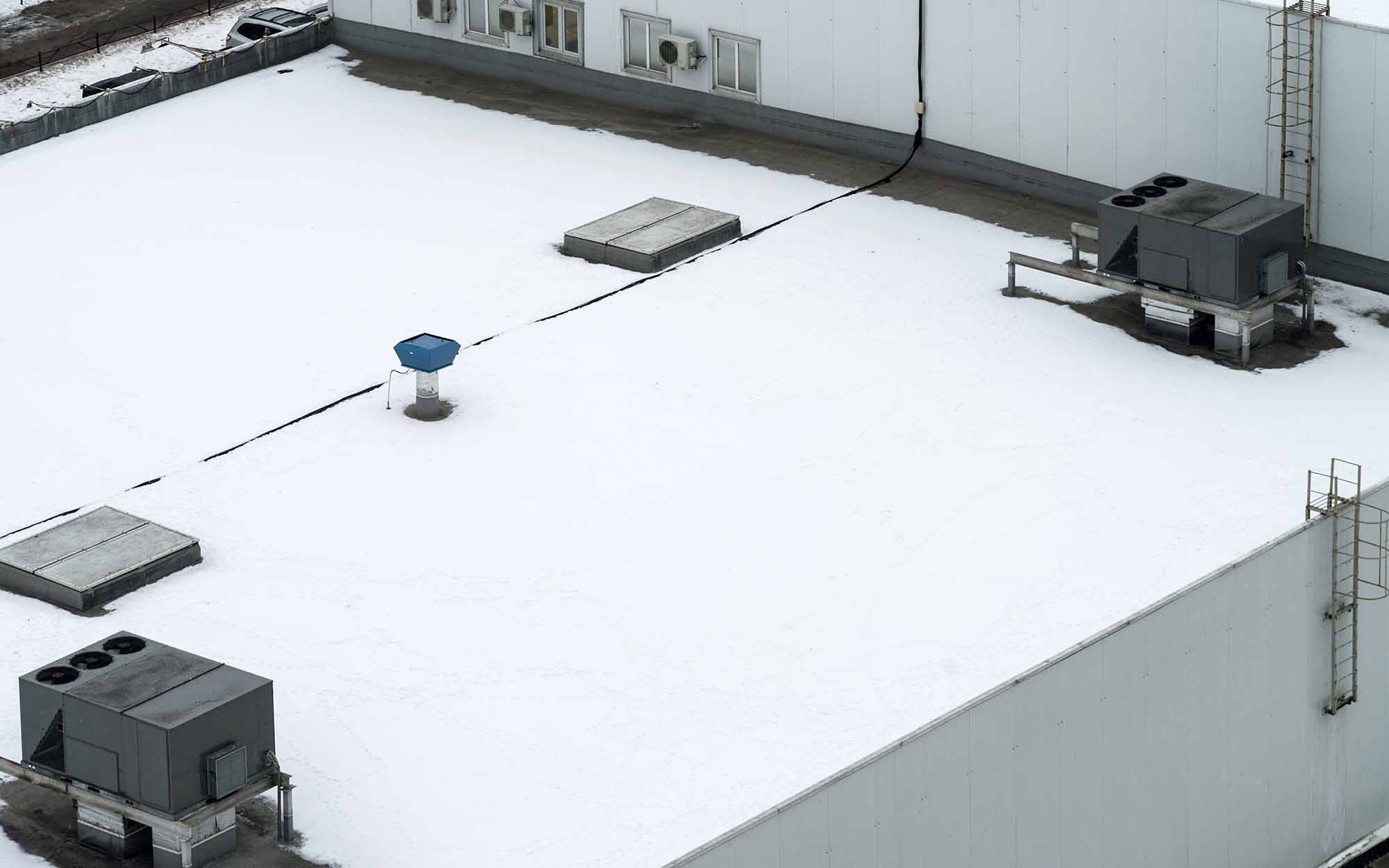
A North Dakota winter tests a commercial roof harder than almost anywhere else in the country. Ground blizzards pile wind-driven snow into drifts several feet deep against parapets and mechanical screens, and the freeze-thaw swings between a January cold snap and a brief mid-winter thaw stress membrane, flashing, and deck fasteners in ways that show up gradually, then all at once as a leak.
Snow and ice claims are some of the hardest commercial roof claims to document well, because the damage is often not visible until conditions allow safe roof access, and by then some of the evidence, drift patterns, the exact drainage failure that let water back up, has already melted away. We prioritize documenting what we can as early as conditions permit.
Snow Load and Drift Patterns on Flat Roofs
North Dakota's open terrain means wind redistributes snow rather than letting it fall evenly, and flat commercial roofs collect drift loads far heavier than the general snowfall total would suggest. Rooftop screens, parapets, and stepped roof levels, common on office and institutional buildings in Fargo and Bismarck, create drift zones where load concentrates. We document drift depth and location where it is safe to do so, and check the roof structure and deck for signs of deflection or stress where heavy drifting occurred.
Ice Damming and Drainage Failure
Low-slope commercial roofs do not get the icicle-hung eaves of a residential roof, but they get the same underlying problem: meltwater refreezing at drains, scuppers, and parapet transitions, backing up behind ice, and finding a way into the building through seams and flashing that were never designed to hold standing water. We check every drain and scupper for ice blockage, trace membrane lift at parapets and curbs back to refreeze cycles, and document interior leak paths against the drainage layout.
Freeze-Thaw Damage Across a Winter
Some of what a North Dakota roof takes over a winter is not one event but a season of repeated freeze-thaw cycling, moisture that gets into a seam or a fastener penetration, freezes, expands, and works the assembly loose a little more each cycle. That kind of gradual deterioration is treated differently by most policies than sudden storm damage, so we document the two separately: acute damage tied to a specific blizzard or thaw event, and longer-term freeze-thaw wear, so it is clear which is which when the claim is reviewed.
Ag-Processing and Industrial Roofs in Winter
Grain elevators and ag-processing facilities near Fargo and Grand Forks, and industrial buildings tied to western North Dakota's Bakken-adjacent activity, often run large, uninterrupted roof spans where a single drift or drainage failure can affect a much larger area than on a smaller commercial building. We scale the drainage and structural review to the roof size, checking every drain path across the field rather than a sample of them.
Building the Winter Claim Record
Once roof access is safe, we document drift and ice patterns, drainage condition, membrane lift, and any structural observations, tied to the storm dates involved. We're your roofing contractor, not a public adjuster, we document and substantiate the roof damage so you and your adjuster work from an accurate scope, and we meet the adjuster on the roof to walk through the same conditions we recorded.
If your building took heavy snow load, ice damming, or freeze-thaw damage this winter, the earlier we can document the roof, the stronger the record for the claim.
Winter Roof Claim Questions Owners Ask
Does insurance cover roof collapse or damage from snow load in North Dakota?
Most commercial property policies cover sudden roof damage from the weight of snow and ice, though language and exclusions vary by carrier and policy. What matters for the claim is documented evidence of the snow load event, the roof's structural response, and the pre-existing condition of the roof deck and drainage. We provide that roof-level record; whether a specific policy covers it is a question for the owner and the carrier.
What does ice dam damage look like on a flat commercial roof?
On low-slope commercial roofs, ice damming shows up less as icicles and more as ponded meltwater backing up behind drain and scupper ice, membrane lifted by refreeze cycles at parapets and curbs, and interior leaks that trace back to a blocked drainage path rather than a single obvious hole. We map those drainage failures and the membrane condition around them.
How do you document a roof after a ground blizzard or heavy snow event?
We photograph snow depth and drift patterns where safely possible, inspect drains and scuppers for ice blockage once conditions allow roof access, and check the underside for signs of deflection, cracked deck, or interior water intrusion. Where snow load is suspected to have stressed the structure, we note deck and fastener condition along with the membrane.
Can freeze-thaw damage from a North Dakota winter be claimed the same way as a single storm?
Freeze-thaw deterioration that builds up over a winter is usually treated differently than damage from a single, dateable event, since many policies distinguish sudden loss from gradual wear. We document both: acute damage tied to a specific storm or thaw event, and longer-term freeze-thaw deterioration, so the owner and adjuster can sort out which applies.
Should snow be cleared before or after the roof is inspected for a claim?
Where it is safe to do so, we prefer to inspect drainage paths and visible membrane condition before extensive snow removal disturbs the evidence, then document again as snow is cleared and more of the roof becomes visible. If active leaking or a structural concern makes emergency snow removal necessary first, we document what we can beforehand and prioritize safety.