
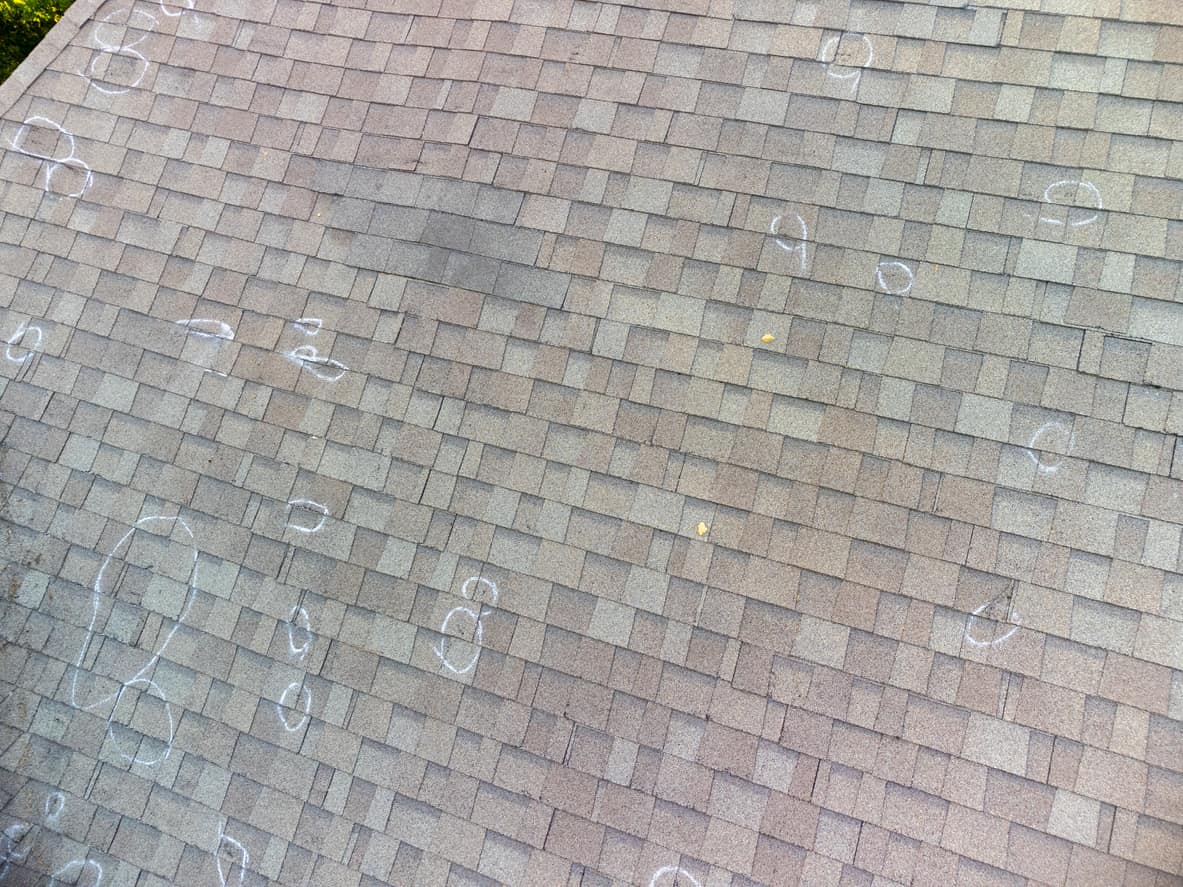
North Dakota sits inside the Northern Plains hail belt, and the storms that move through in late spring and summer can drop stones large enough to crack skylight domes and dent standing-seam metal within a few minutes. The damage to a flat commercial roof is rarely as obvious as a shattered car windshield, it shows up as bruised membrane, cracked coating, and fractured granules that only a roof-level inspection will catch.
Hail is one of the most common storm perils behind commercial roof insurance claims in this state, and it is also one of the easiest to underscope if the inspection stops at a visual walk from the roof hatch. We probe suspect areas, mark impact points, and photograph patterns across the entire roof field rather than only the section closest to the access point.
Reading Hail Damage on Different Roof Systems
Hail affects every commercial roof membrane differently. TPO and PVC single-ply can show splitting or fractured seams at impact points; EPDM often bruises without an obvious surface mark, which is why we probe rather than rely on sight alone. Modified bitumen and BUR lose granules in a scattered pattern that is easy to mistake for normal aging unless it is mapped against the storm track. Standing-seam and R-panel metal roofing, common on warehouse and ag-processing buildings around Fargo and Grand Forks, dents visibly but the functional damage, compromised finish, stress at seams, needs a closer look than a dent count.
Why Rooftop Equipment Gets Missed
Adjusters scoping a hail claim quickly sometimes focus on the membrane and skip the rooftop units, skylights, and edge metal that took the same storm. Condenser fins bend, curb flashing cracks, and coping on a building's leeward parapet can take impacts an owner never sees from ground level. We document equipment and edge conditions with the same rigor as the roof field, because a scope that misses a damaged condenser or a cracked skylight dome is an incomplete scope.
Grain, Industrial, and Institutional Roofs After Hail
A grain-handling or ag-processing roof near Grand Forks carries different risk than a hospital or university roof in Fargo or Bismarck, access, downtime tolerance, and the cost of a missed leak are all different. Western North Dakota's industrial and warehouse buildings tied to Bakken-area activity often have large, uninterrupted roof fields where hail damage can spread across thousands of square feet before anyone on the ground notices a leak. We scale the inspection to the roof size and the building's use, but the documentation standard stays the same everywhere in the state.
Building the Claim Record
Once the roof walk is complete, we put together a report tied to the storm date: photo-documented impact locations, test-cut findings where they were needed, membrane and equipment condition notes, and a summary of the affected roof area. We're your roofing contractor, not a public adjuster, we document and substantiate the roof damage so you and your adjuster work from an accurate scope, and we meet the adjuster on the roof to walk through that record in person.
If a recent hailstorm crossed your property anywhere from the Red River Valley to the Missouri River corridor, an inspection before you file, or before the adjuster's visit if the claim is already open, gives you a documented starting point instead of a guess.
Hail Claim Questions Owners Ask
How do you tell hail damage from normal roof wear?
Hail leaves a distinct signature: circular bruising on membrane that feels soft or spongy under a probe, fractured or missing granules in a scattered pattern on modified bitumen, and dents on metal edge, coping, and rooftop unit housings. Normal wear tends to be uniform and follows drainage paths and traffic areas rather than the random scatter of a hail event. We photograph and mark both so the difference is documented on the record rather than asserted from memory.
Does one hailstorm justify a full commercial roof replacement?
It depends on how densely the impacts are spread across the roof field and whether the membrane's remaining service life supports patch repair. If test cuts and impact counts show damage scattered broadly enough that spot repairs would not restore the roof's performance, replacement is the scope we document and support. A handful of isolated impacts on an otherwise sound roof is a different conversation.
How soon after a North Dakota hailstorm should the roof be inspected?
As soon as it is safe to get on the roof. Hail bruising on membrane can be harder to identify weeks later once the material has had time to settle, and metal dents can get overlooked in the general cleanup after a storm. An early inspection also gives us a documented timestamp tied to the storm date, which carriers weigh heavily.
Do rooftop units and edge metal get checked, or just the membrane?
Both. Hail dents condenser fins, damages curb flashing, and cracks skylight domes as readily as it bruises membrane, and adjusters sometimes scope only the roof field if nobody points out the equipment damage. We walk the full roof, including every curb, unit, and edge condition, and document each separately.
Can hail damage be hidden under a roof coating or recent recover?
Yes, and it is one of the harder scopes to document. A coating or recover layer can mask bruising and granule loss underneath, so we probe through the surface layer and pull test cuts where the coating history is unclear, rather than assuming the newer surface means the roof escaped damage.