
Big roofs over busy rooms
Fargo takes its recreation seriously, and the buildings show it. From the Fargodome on the NDSU campus to Scheels Arena on the south side, the city's community pools and ice sheets, the field houses and club gyms along 45th Street and out toward Veterans Boulevard, these are wide, column-free rooms full of people. The roofs that cover them are nothing like a flat retail box. They span long distances on a single structural system, they carry dense rooftop ventilation sized for crowd-level occupancy, and many of them sit over enough interior moisture to wreck a poorly built assembly. We design for the room underneath, not from a generic flat-roof scope.
Two Fargo realities shape every one of these projects. The first is snow. A long clear-span roof collects and drifts North Dakota snow, and the structural deck plus the fastening pattern have to be engineered for that load across the full span. The second is the calendar, rec buildings program nights, weekends, and holidays, exactly when crews would rather not be on a roof. We work the schedule we are given and dry the roof in before the doors open, rather than asking a community to give up its court time.
Clear-span decks and snow load
A gym or arena roof might run sixty, eighty, or more feet between supports, and that span does three things to the roofing problem. It deflects under load, so the membrane and flashings have to tolerate movement. It collects drifting snow unevenly, piling extra weight against parapets and at roof-level steps. And it makes the fastening pattern a structural calculation, not a default, pull-out values for steel deck at an eighty-foot span are not the values at thirty feet, and a pattern copied off a small-building detail will not hold in a Fargo blizzard. We evaluate the actual deck and span, run the attachment to the real wind and snow loads, and detail the perimeter where uplift concentrates.
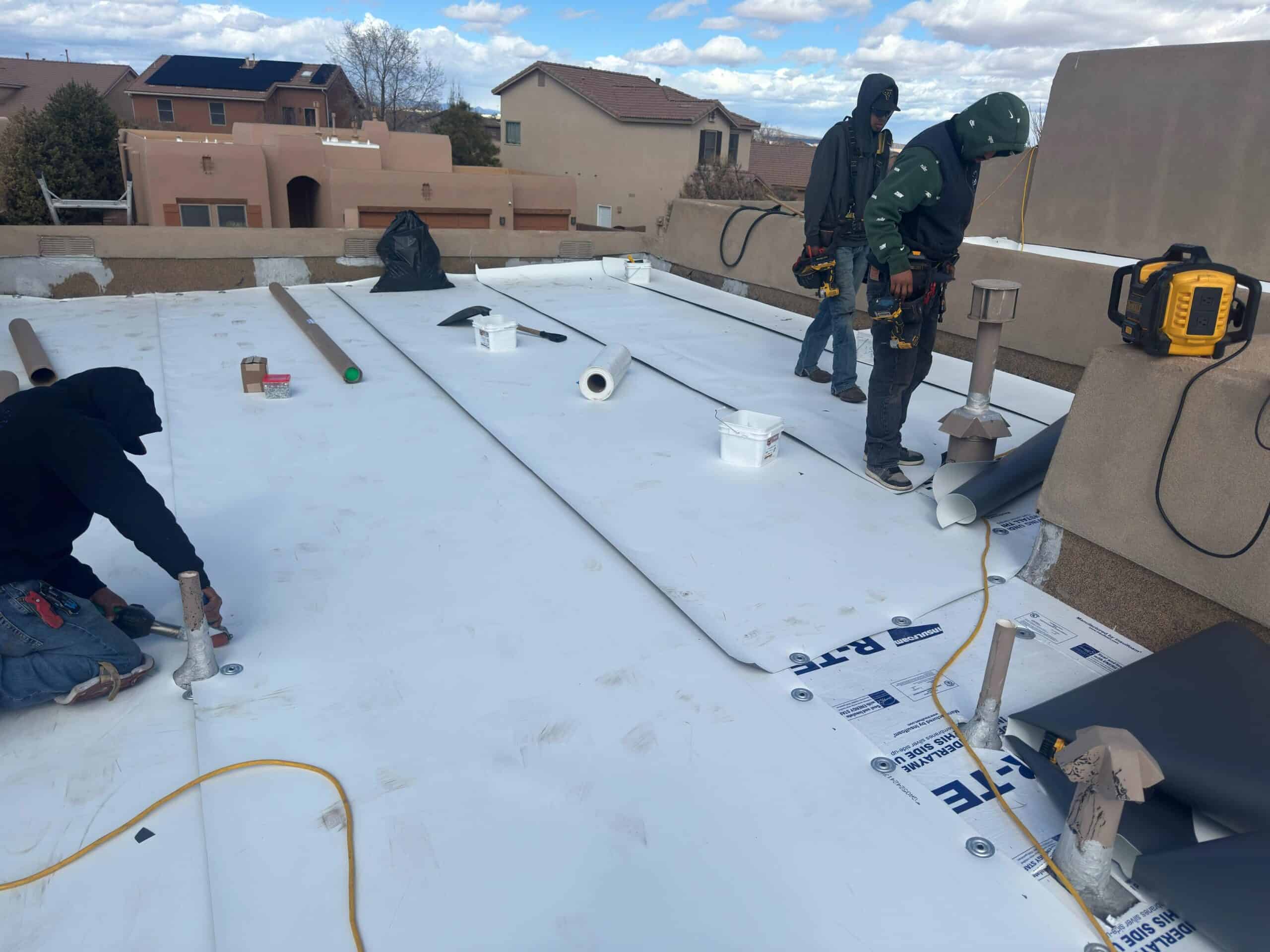
For most of these large decks we run a thick mechanically attached single-ply over polyiso, with the fastening designed to the specific deck and span and tapered insulation added where drainage is deficient. Where a roof is structurally sensitive we confirm the deck capacity before we add insulation thickness, because the last thing a long-span roof needs is unplanned dead load.
Natatorium humidity is its own animal
An indoor pool is the hardest roof in this category, and it is not just the humidity, it is the chemistry. Chlorine reacts with what swimmers bring into the water and gives off chloramine gas, which rises into the roof zone and corrodes ordinary metal flashing, aluminum edge, and some adhesives. Over a Fargo winter that warm, chloramine-laden air also wants to condense against a cold deck, so the pool hall punishes the assembly from inside while the climate pushes from outside. We treat the natatorium as a corrosion problem: stainless or copper flashing where the gas concentrates, a membrane confirmed compatible with chloramine exposure, and a vapor retarder positioned for the pool's real operating conditions so the moisture does not drive into the deck.
- Arenas and field houses, long spans, heavy ventilation, and snow drifting that the attachment pattern has to account for.
- Aquatic centers and natatoriums, chloramine-rated flashing and adhesives plus vapor control sized for the pool, not a generic spec.
- Gyms and locker-room wings, high occupancy humidity and a vapor retarder placed for the Fargo climate so condensation stays out of the assembly.
Vapor control and a moisture check before we recover
The fastest way to make a recreation roof worse is to recover over a wet assembly. High-occupancy gyms, locker rooms, and pool halls all drive interior vapor upward, and if the existing retarder is missing or misplaced the insulation below is often already saturated. Before we scope a reroof on any humid recreation building we run a moisture survey, because layering new membrane over trapped water just seals the problem in. We place the vapor control layer for the actual interior load and the local climate, a wet desert spec is wrong here, and so is a humid-coastal one.
Programming, public bids, and getting it dried in
Recreation roofing follows the building's calendar. Gym and arena work concentrates in weekday daytime hours with the roof dried in before evening leagues and events; pool-hall HVAC or exhaust work is coordinated with the aquatics team so air exchange over the water is not interrupted while swimmers are present. Many of these facilities are public, run by the city, the park district, or a Y, which means public bid advertising, bid and performance bonding, and prevailing-wage compliance where it applies. We carry the bonding and insurance for public work in North Dakota and handle the contract documentation, and we navigate the membership-and-event scheduling that private clubs and entertainment venues run on just as readily.
Sports and recreation roofing questions
How do you keep pool and locker-room humidity out of the roof?
With a vapor retarder placed correctly for the interior load and the Fargo climate, confirmed by a moisture survey before we recover. Recovering over a wet or misspecified assembly seals moisture in and accelerates the failure, so on any aquatic or high-humidity building the survey comes first.
What flashing survives a natatorium?
Stainless steel or copper in the areas where chloramine concentrates, a membrane confirmed compatible with chloramine exposure, and adhesives rated for pool-hall conditions. Standard metal edge and ordinary adhesives corrode in that air, so the natatorium gets its own spec.
How do you handle a long gymnasium or arena span?
We treat the attachment as a structural calculation. The deck type and span set the fastener pull-out values and the perimeter uplift detailing, and we design the pattern to the real wind and snow loads rather than copying a small-building detail that will not hold here.
Can you work around our event and league calendar?
Yes. Roof work runs in the daytime windows you give us with a confirmed dry-in before evening programming, and pool-hall ventilation work is coordinated with your aquatics team so air exchange over the water is never interrupted while swimmers are in the building.
Do you handle public bids for city and park-district facilities?
Yes, bid advertising, bid and performance/payment bonds, and prevailing-wage compliance where it applies. We carry the required bonding and insurance for public work in North Dakota and handle the municipal contract documentation.