
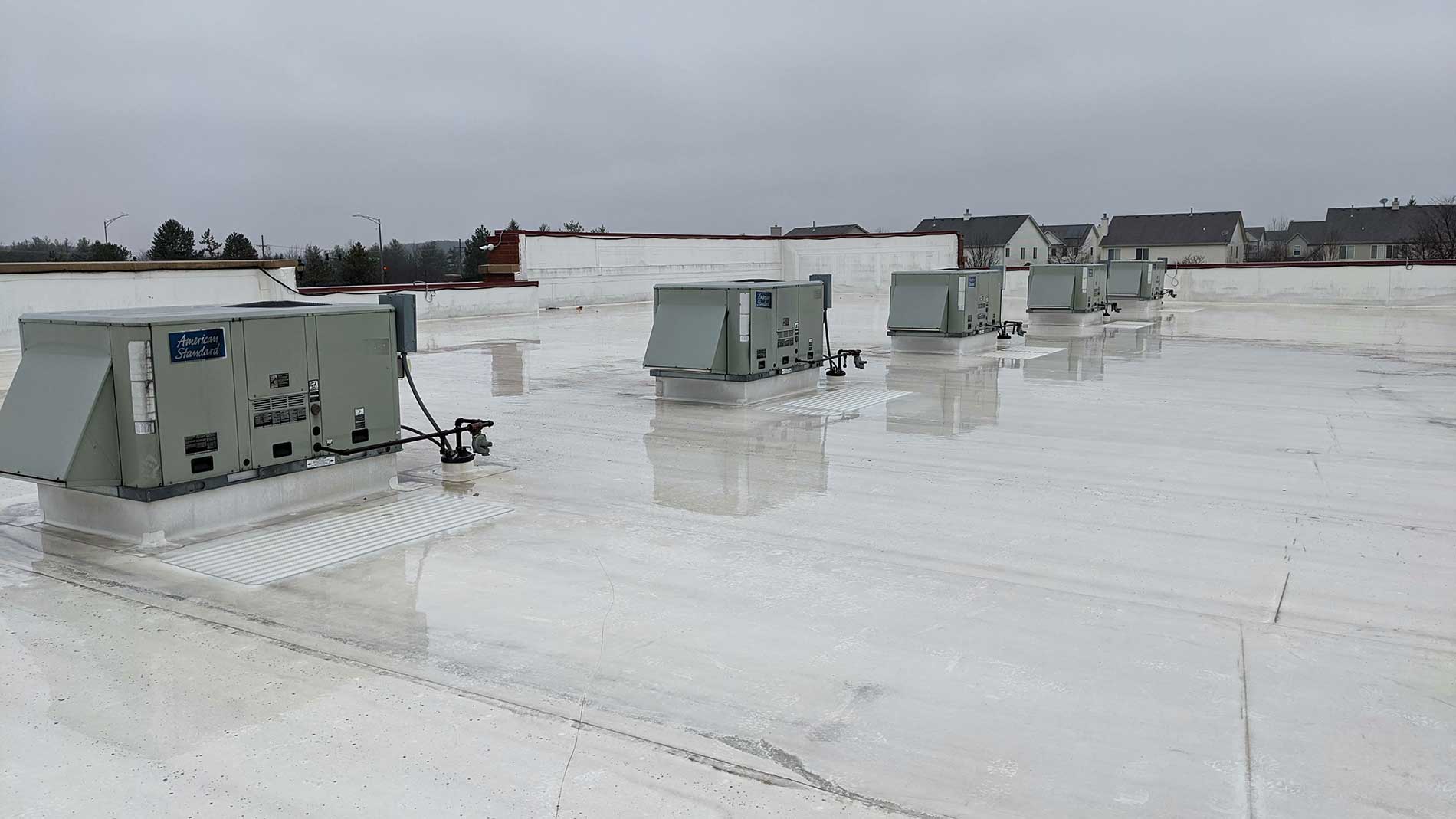
Fargo's restaurant scene has grown well beyond its Great Plains reputation, with the downtown Broadway corridor's gastropubs and craft breweries drawing residents and visitors year-round, the West Fargo commercial strip feeding a growing suburban population with QSR franchises and fast-casual concepts, and the University District's dining options running at full capacity through the school year. What every food-service building in the Fargo-Moorhead metro has in common is exposure to one of the harshest roofing climates in North America, where winter temperatures reach minus 30 degrees Fahrenheit, blizzards deliver dense wet snow in quantities that test structural capacity, and freeze-thaw cycling in spring compresses months of roof stress into weeks.
Snow load management is not a background concern in Fargo,it is an active operational responsibility for restaurant building owners. North Dakota's commercial building code sets snow load requirements that account for ground snow loads that can exceed 50 pounds per square foot in major accumulation years, and commercial roof systems must be designed and maintained to handle those loads without ponding or structural deflection that compromises membrane integrity. Restaurant owners in the downtown Fargo core need to be aware that adjacent buildings, parapets, and rooftop equipment can cause snow drifts that add concentrated loads above design values in specific areas. Drift load analysis during a re-roof project ensures that insulation slope-to-drain is adequate and that equipment placement doesn't create accumulation traps.
Grease exhaust flashing at sub-zero temperatures presents a technical challenge that is unique to northern markets like Fargo. When a commercial kitchen runs overnight and then shuts down in January, the exhaust system cools from operating temperature to ambient within an hour or two, and any grease condensate that collected on the stack interior congeals into a solid mass that can partially block exhaust flow when the kitchen opens the next morning. More importantly for roofing purposes, that congealed grease holds ice against the flashing collar through extended cold periods, and the daily cycling between kitchen operating temperature and overnight ambient causes micro-movement at the penetration that eventually works open sealant joints. Fargo roofing contractors who specialize in food-service buildings use low-temperature-rated urethane caulks rather than standard silicone at exhaust penetrations, extending sealant service life significantly in the extreme cold.
Walk-in cooler and freezer curb transitions on Fargo restaurant roofs experience the most demanding thermal environment in the country for vapor management. With exterior temperatures at minus 20 and a walk-in freezer interior at minus 10, the temperature differential across the roof assembly is actually small compared to summer conditions, but the vapor drive toward the exterior cold side during shoulder seasons creates significant condensation risk within the insulation layer. North Dakota energy code requires commercial roofs to meet high R-value minimums that drive insulation thicknesses above what southern markets specify, and the additional insulation depth means vapor retarder placement is even more critical because the temperature gradient across a thicker assembly creates a larger zone where condensation can form if the retarder is incorrectly positioned.
The craft brewery and taproom corridor defined by downtown Fargo and extending into the Moorhead commercial district represents some of the most demanding roofing environments in the region. Fargo's brewing operations run year-round in buildings that see sustained periods of minus 20 temperatures outside while maintaining warm, humid interior environments during active fermentation. The resulting vapor pressure differential is extreme, and older commercial buildings that were converted to brewery use without addressing the roof assembly's vapor management often develop wet insulation pockets within two to three years of opening. A comprehensive re-roof for a Fargo taproom includes vapor retarder specification, insulation replacement where wet areas are confirmed by infrared survey, and membrane installation with attention to curb heights that prevent ice damming at equipment transitions.
Franchise QSR operators along 13th Avenue South and 32nd Avenue in West Fargo navigate a maintenance cycle that is more compressed than their counterparts in warmer markets because roofing deterioration accelerates in Fargo's climate. A franchise location that might go 15 years between re-roofs in Phoenix will typically need attention at 10 to 12 years in Fargo because freeze-thaw cycling cumulatively stresses seams and flashings in ways that steady-state temperature environments don't. Corporate property standards inspections that note roofing deficiencies during Fargo winter visits often result in mandatory repair timelines that, because they arrive during the roofing off-season, require planning that wouldn't be necessary in year-round installation climates. Fargo franchise operators who schedule proactive re-roofs in the fall control the timeline rather than reacting to corporate mandates in February.
Health and safety oversight of Fargo food-service establishments falls under the Cass County Health Department, and inspectors who note physical plant deficiencies related to roofing,ceiling moisture, mold in prep areas, pest entry at deteriorated flashing,issue correction notices that require documented repair. The Fargo climate adds urgency to those notices because a repair window in January or February is not just logistically difficult but potentially limited to emergency patch work rather than a proper fix. Restaurant operators who receive a roofing-related health code citation in winter typically need to demonstrate both an emergency interim repair and a commitment to full remediation during the spring installation window, a two-stage documentation process that is familiar to roofing contractors who work regularly with Fargo food-service operators.
Membrane selection for Fargo restaurant re-roofing should be driven by cold-temperature performance above all other considerations. TPO membranes formulated for cold-climate applications maintain adequate flexibility at minus 30 degrees Fahrenheit and retain heat-weld strength through repeated freeze-thaw cycles, making them the standard specification for Fargo commercial food-service buildings. Some roofing contractors in the Fargo market prefer PVC for the flexibility advantage at extreme cold temperatures, and for very northern locations or buildings with unusually high mechanical equipment density, PVC's cold-temperature properties make it a defensible premium specification. In either case, 60-mil thickness is the minimum for food-service buildings that will see rooftop foot traffic from HVAC service technicians during winter maintenance visits.
The scheduling window for Fargo restaurant re-roofing is tightly constrained compared to most U.S. markets. Reliable installation conditions exist from approximately mid-May through mid-October, and within that window, July and August represent the peak months for both membrane installation quality and contractor availability. Restaurant owners who defer re-roofing assessments until spring often find the best contractors already booked for the prime summer window, forcing either a second-tier contractor or a fall installation that competes with harvest season activity and risks early frost. Getting an assessment completed in January or February,even when repairs can't begin until spring,locks in contractor availability and allows permit applications to be submitted before the installation season opens.
- How does Fargo's extreme cold affect grease exhaust flashing sealants on restaurant roofs?
- Standard silicone sealants rated to minus 40 degrees Fahrenheit can become brittle at Fargo's extreme winter temperatures when combined with the micro-movement created by kitchen exhaust cycling from operating temperature to overnight ambient. Low-temperature urethane caulks that retain elasticity throughout the full Fargo temperature range,from minus 30 in winter to 95 degrees in summer,outlast standard silicone at exhaust penetration collars by several years in North Dakota's climate. Annual inspection and targeted resealing of exhaust penetration flashings before the first sustained cold period in October is the most cost-effective maintenance practice for Fargo restaurant building owners.
- What snow load considerations are critical for Fargo restaurant re-roofing?
- North Dakota's ground snow load requirements for the Fargo area can reach 50 pounds per square foot in major snow years, and drift accumulations around parapets, equipment screens, and adjacent building walls can significantly exceed field load values at concentrated points. During a commercial re-roof, the contractor should verify that the roof slope-to-drain design provides positive drainage to prevent ponding under melt conditions and that equipment placement avoids creating snow trap configurations. Adding insulation above an existing roof assembly also increases dead load, and a structural engineer should review the cumulative load calculation before specifying thick insulation layers on older Fargo commercial buildings.
- Why is the Fargo re-roofing season so short compared to southern markets?
- Commercial membrane welding requires ambient temperatures above 40 degrees Fahrenheit for reliable seam quality, and Fargo's climate reliably meets that condition only from mid-May through mid-October, a window of roughly five months compared to the nine or ten months available in southern markets. Within that window, contractor demand is concentrated in July and August when conditions are most favorable, creating booking lead times of four to six months for the best commercial roofing crews. Fargo restaurant owners who want high-quality installation at favorable pricing should complete assessments and sign contracts in February or March for summer installation rather than waiting until spring to begin the search.
- How does vapor retarder placement differ for walk-in freezer areas in Fargo compared to warmer climates?
- In Fargo's climate zone 7, the dominant vapor drive direction is from the warm interior toward the cold exterior throughout the long heating season, meaning the vapor retarder must be placed at or immediately above the structural deck,on the warm side of the insulation assembly,to stop moisture before it enters the insulation layer. Placing the retarder in the middle of the insulation assembly, as is sometimes specified in mixed-climate zones, traps moisture within the lower insulation layer rather than blocking it at entry. A roofing contractor who understands North Dakota climate zone requirements will specify retarder position based on ASHRAE Zone 7 analysis rather than applying a generic national specification.
- What should a Fargo restaurant owner do if a health code citation is issued for roofing in winter?
- A winter roofing-related health code citation in Fargo typically requires a two-stage response: an emergency interim repair to stop active water entry or address the immediate health condition, followed by a documented commitment to full remediation during the spring installation window with a specific timeline and contractor agreement. The Cass County Health Department is familiar with North Dakota's installation season constraints and generally accepts a written contractor commitment letter specifying the spring repair scope and estimated start date as sufficient documentation to close a winter citation, provided the interim repair has addressed the immediate food-safety risk. Having an established roofing contractor relationship makes producing that documentation fast and credible.
Questions Building Owners Ask
What usually changes the price for acrylic and silicone roof coatings?
For acrylic and silicone roof coatings, access, wet insulation, deck repair, edge metal, drains, temporary protection, after-hours work, and occupied-building staging change the number faster than the roof label. We verify those acrylic and silicone roof coatings conditions around Casselton before treating a square-foot price as reliable.
Can acrylic and silicone roof coatings be handled while the building is occupied?
Often, but the acrylic and silicone roof coatings sequence has to be planned. We review entrances, loading docks, patient or tenant areas, roof access, odor sensitivity, and weather windows near Veterans Boulevard Corridor before recommending daytime, phased, or after-hours work.
How do we know if acrylic and silicone roof coatings should be repair, coating, recover, or replacement?
We look at acrylic and silicone roof coatings through wet insulation, deck condition, attachment, slope, seam condition, drain performance, and edge-metal risk. If the roof around June normal precipitation of 4.29 inches is dry and stable for acrylic and silicone roof coatings, preservation options stay on the table. If moisture or deck damage is spreading through acrylic and silicone roof coatings, replacement planning becomes more defensible.
What documentation do we get after a acrylic and silicone roof coatings inspection?
Typical acrylic and silicone roof coatings documentation includes roof-area notes, photo locations, leak or damage observations, priority levels, repair limits, access constraints, and budget categories. On storm work tied to acrylic and silicone roof coatings, we provide contractor-side roof evidence without promising insurance outcomes.
How quickly can you look at acrylic and silicone roof coatings after a leak or storm?
Timing for acrylic and silicone roof coatings depends on weather, crew load, access, and whether interior water is active. We triage emergency conditions first, especially when water is entering occupied space near healthcare campus roofs, and then separate temporary dry-in from permanent scope.