Industrial facilities across North Dakota and the Fargo-Moorhead corridor operate under some of the harshest roofing conditions on the continent. When temperatures swing from 100°F summer highs to −40°F wind-chill events in winter, every seam, fastener, and membrane on your facility's roof faces extraordinary stress. Our industrial roofing team has spent years working on the manufacturing plants, rail terminals, agricultural processing facilities, and distribution centers that form the backbone of the region's economy, and we understand what it takes to keep a large commercial roof performing through North Dakota's brutal seasonal extremes.
The Fargo-Moorhead industrial corridor is headlined by significant infrastructure that demands specialized roofing expertise. BNSF Railway operates one of its most important rail junctions in Fargo, supporting massive maintenance and intermodal facilities that require durable, low-maintenance roofing systems capable of resisting decades of freeze-thaw cycling. Bobcat Company's West Fargo manufacturing campus, Amazon's Fargo distribution center, and the dozens of agricultural equipment dealers, steel fabricators, and cold-storage operators that cluster around the I-29/I-94 interchange all require roofs engineered for industrial-grade service life.
The Bakken oil field and Williston Basin energy corridor has also generated substantial industrial roofing demand across western North Dakota. Equipment staging yards, pipe storage facilities, pump station buildings, and oilfield services warehouses throughout Minot, Williston, Dickinson, and Bismarck require roofing that can absorb the thermal shock of extreme temperature swings without cracking or delaminating. Our crews work across the entire state, not just the metro area, because industrial activity in North Dakota spans hundreds of miles.
Standing seam metal roofing is one of the most specified systems for North Dakota industrial facilities because it handles snow load accumulation, thermal movement, and high-wind events better than almost any other option. With an average of 40 inches of annual snowfall in the Fargo area and regular blizzard conditions that can deposit much more in a single event, your roof structure and membrane must work together to manage both the weight and the melt cycle that follows. We install and service metal roofing, TPO single-ply membranes, EPDM rubber systems, and modified bitumen assemblies, all with appropriate vapor retarder strategies for a climate where indoor-outdoor temperature differentials can exceed 100 degrees.
Spring flooding risk is a factor that many facility owners overlook when evaluating their roofing systems. The Red River Valley's flat topography and heavy snowmelt create conditions where standing water on low-slope roofs can persist for extended periods. We engineer drainage solutions with adequate slope, oversized drain bowls, and secondary overflow scuppers that ensure water exits your roof quickly. Ponding water accelerates membrane degradation and, in a freeze-thaw environment, creates ice dams that can force water beneath laps and seams with tremendous pressure.
Wind is among the most underestimated forces acting on industrial roofs in the northern plains. Open terrain around Fargo and across the prairie creates long fetch distances that allow wind to build significant velocity before striking your building. Edge details, corner zones, and parapet flashings are the most vulnerable areas, and we install enhanced mechanical fastening patterns and wider bonded seam widths at these locations to meet and exceed local wind uplift requirements. Our work is engineered to current International Building Code standards and North Dakota-adopted amendments.
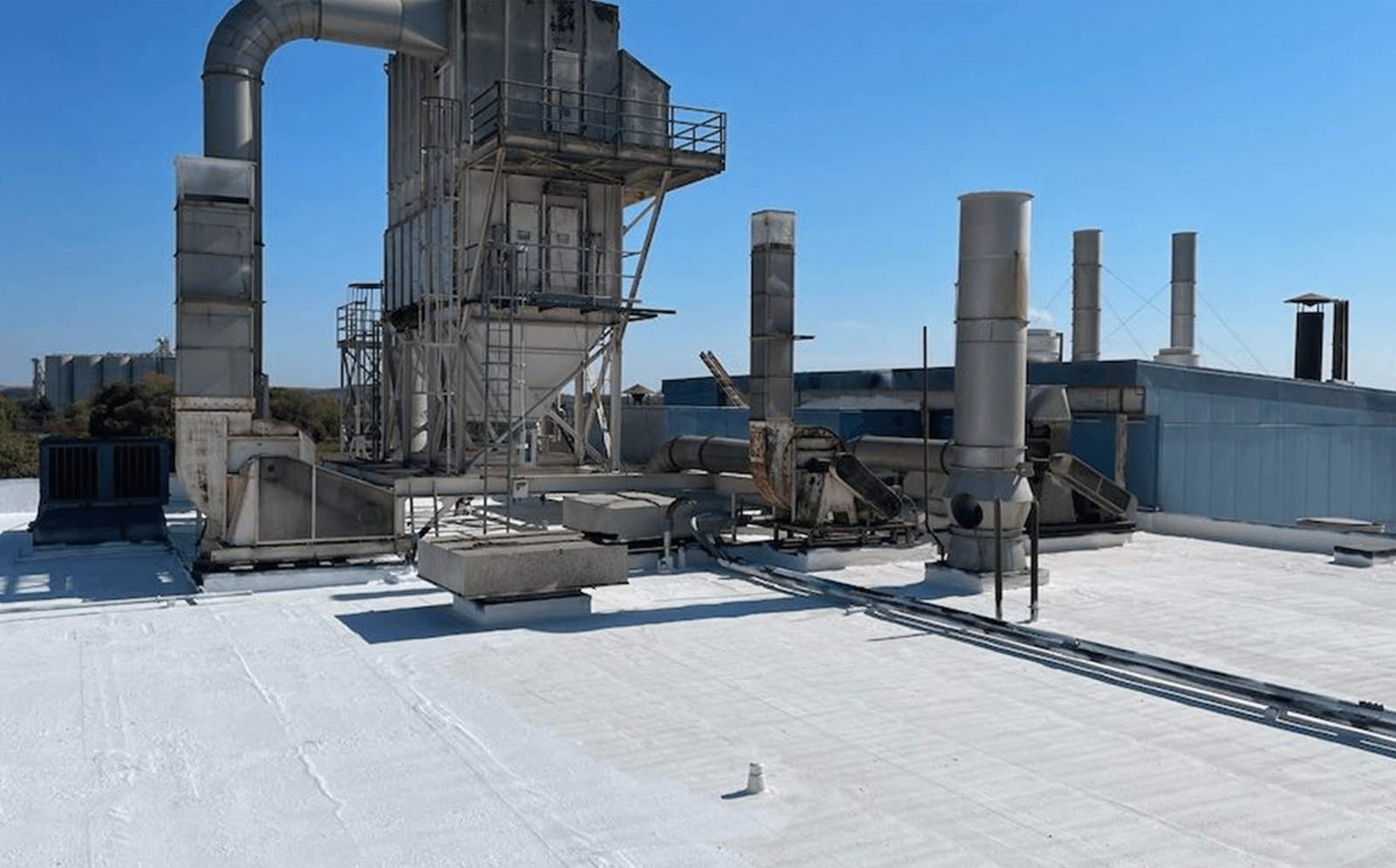
Industrial roof coatings have become an increasingly important tool for extending the service life of existing assemblies on large-footprint facilities. A reflective silicone or acrylic coating applied over a sound but aged membrane can add 10 to 15 years of service life at a fraction of full replacement cost. For North Dakota facilities, however, coatings require careful timing, application temperatures must be suitable, and the coating must fully cure before the first freeze. Our project scheduling accounts for the region's narrow application windows and we use low-temperature-tolerant products where appropriate.
Energy efficiency is a significant operational concern for industrial facility owners in a climate where heating loads are among the highest in the nation. Upgrading roof insulation to current code minimums, or beyond, during a re-roofing project delivers measurable reductions in natural gas consumption. We evaluate existing R-values, identify thermal bridging paths through metal decks and structural members, and specify tapered insulation systems that simultaneously improve drainage and thermal performance. Many of our industrial clients in Fargo and across North Dakota have seen heating cost reductions that help offset the cost of a new roofing system within a few years.
Emergency response capability matters in a state where a sudden late-season blizzard or severe thunderstorm can compromise a roof and leave valuable equipment, inventory, or production lines exposed. We maintain emergency response resources and can deploy crews for temporary weatherproofing and damage assessment quickly after severe weather events. We also work directly with insurance adjusters and provide detailed documentation packages to support claims for hail, wind, and ice damage, all of which occur regularly in North Dakota.
From the grain elevators of the Red River Valley to the aerospace maintenance facilities near Grand Forks Air Force Base, North Dakota's industrial sector depends on roofing contractors who treat a project as an engineering problem, not just a material installation. Our team brings manufacturer certifications, OSHA-compliant safety programs, and decades of cold-climate roofing experience to every industrial project we take on. If your facility is due for inspection, repair, or full replacement, we invite you to contact us for a comprehensive assessment and a project proposal tailored to your building, your budget, and North Dakota's demanding environment.
Questions Owners Ask
How does extreme cold affect my industrial roof and what should I inspect each spring?
Repeated freeze-thaw cycles cause membranes to contract and expand, stressing seams, flashings, and penetrations. Each spring, prioritize inspection of field seams on single-ply systems, perimeter edge metal terminations, pipe boot flashings, HVAC curb flashings, and any area where ponded melt water collected. Look for lap separations, membrane shrinkage cracks, and corrosion on metal components. Early identification of minor defects prevents water infiltration that can saturate insulation and destroy deck integrity over multiple winters.
What roofing system is best for a large industrial building in Fargo that carries heavy snow loads?
Standing seam metal roofing with structural support designed for North Dakota's ground snow load requirements is often the preferred choice for long-span industrial buildings. Metal panels shed snow efficiently on appropriate slopes and have proven service lives exceeding 40 years. For low-slope or flat roofs, mechanically attached TPO with heavy-duty fastening in corner and perimeter zones provides the wind uplift resistance the region demands. Insulation thickness should be specified to meet current energy codes and prevent condensation within the assembly given the extreme indoor-outdoor temperature differentials typical of North Dakota winters.
Can I coat my existing industrial roof to extend its life rather than replacing it?
Yes, if your existing membrane is structurally sound and insulation has not been compromised by moisture intrusion, a properly applied silicone or acrylic coating system can extend service life significantly. The critical step is a thorough moisture scan, using infrared thermography or nuclear moisture detection, to confirm that wet insulation is not present. Coating over saturated insulation traps moisture and accelerates deterioration. For North Dakota facilities, coating projects should be completed in late summer to ensure adequate curing time before freezing temperatures arrive.
How do we manage industrial roof maintenance across multiple sites in North Dakota?
We offer structured preventive maintenance programs designed for multi-site industrial portfolios. Each facility receives documented semi-annual inspections with written reports, photo records, and prioritized repair recommendations. We establish a master service agreement that covers emergency response, minor repairs, and annual reporting, giving you a single vendor relationship and consistent documentation across all your North Dakota locations. This approach also simplifies budget forecasting by providing a rolling 5-year capital expenditure projection based on the condition of each roof.
What documentation do I need from a roofing contractor for insurance and warranty purposes?
For industrial roofing projects, you should receive a manufacturer's material warranty (typically 15 to 30 years for NDL, No Dollar Limit, coverage), a contractor workmanship warranty, OSHA-compliant safety plan documentation, project as-built drawings showing drain locations and penetration details, and a final inspection report signed by the manufacturer's representative. For insurance purposes, a roof condition report with photographs taken before, during, and after the project provides essential documentation for future claims. We provide a complete documentation package on every project as a standard deliverable.