
A small roof that everyone is looking at
A bank branch is a small building with an outsized standard for how it has to look and perform. The flat roof itself might only be a few thousand square feet, but it sits on a high-visibility corner where the parapet, the fascia, and the drive-through canopy are part of the brand the customer sees on the way in. Fargo's financial footprint is heavy for a metro this size — Bell Bank and Gate City Bank are headquartered here, the city is a regional banking hub for the Red River Valley, and branches line 13th Avenue South, the 45th Street corridor, and University Drive, with corporate offices downtown along Broadway. Every one of those roofs is small, prominent, and sitting directly over operations that cannot get wet.
More penetrations than the footprint suggests
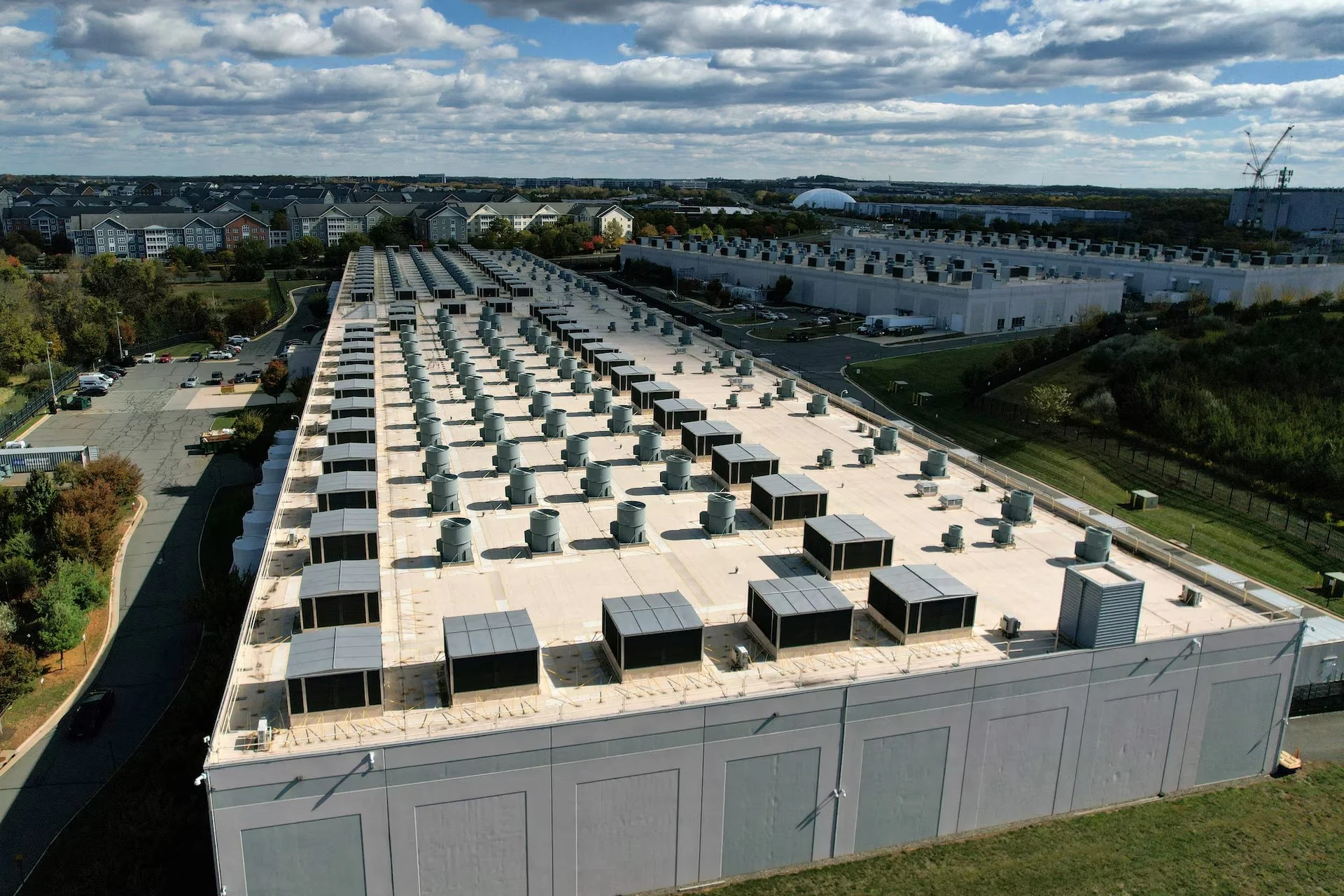
A bank roof is busier than its size implies. Below the membrane you have the vault, server and network rooms, and customer-facing floors, and above it you find precision cooling units for the equipment rooms, generator and transfer-switch exhaust, ATM and night-deposit enclosures, and the structural connections for the canopy and signage. For a roof that small, that is a dense cluster of curbs and penetrations, each one a discrete flashing detail. The stakes per square foot are unusually high too: a minor leak that would be a nuisance over a warehouse becomes an immediate business event when it lands over a vault, a teller line, or a rack of servers.
The drive-through canopy is the usual culprit
If a bank branch leaks, the canopy is where we look first. The drive-through canopy-to-building connection is the single most common chronic leak on these properties, and for good reason — it takes brutal thermal cycling through a North Dakota year, it catches overspray and road chemical off vehicles, and the canopy and the main structure settle and move at slightly different rates, working the joint loose over time. Standard retail flashing details are not built to take that abuse for the long haul. We treat the canopy transition as its own scope item, evaluate it on its own, and re-flash it with a detail designed for differential movement. Replacing the field membrane and ignoring the canopy is how a branch gets a fresh roof and the same leak.
Appearance is part of the spec
Because the roofline of a bank is so visible from the street and the drive-through lane, the edge metal, the parapet caps, and the canopy finish are not afterthoughts. Sagging or stained fascia, mismatched coping, or a patched-looking canopy reads as neglect on a building whose entire job is to project stability. We hold the visible details to a higher finish standard on financial buildings and coordinate any color and profile choices with the brand's image standards. The roof has to be watertight first, but on a bank it also has to look like nothing is wrong.
The right system for a small, exposed roof
A small bank roof is, proportionally, almost all edge and penetration — there is very little open field membrane between the parapet and the next curb. That changes what we specify. We lean toward fully adhered single-ply on these buildings because there is so little uninterrupted field to mechanically attach, and an adhered system handles the high perimeter uplift on an exposed corner lot better than a fastened sheet with seams running through a small area. Reflective white TPO or PVC also meets the cool-roof line most reroof permits now carry and keeps summer load off the equipment rooms below. The edge metal gets engineered to the wind zone rather than stocked off the truck, since on a roof this size the perimeter is doing most of the work holding the system down.
Winter at the canopy and the drains
Fargo winters punish the exact details a bank roof depends on. The drive-through canopy collects snow and forms ice at the building joint, and the freeze-thaw cycle there works a marginal flashing apart faster than anything else on the property — one more reason we treat that transition as its own scope. On the main roof, a small flat deck behind a parapet drifts and ponds, and a single blocked drain under a melting load puts standing water over a vault or server room within hours. We confirm positive drainage, keep the overflow scuppers clear, and detail the canopy and parapet to take the ice loading these buildings see every year.
Security shapes the schedule before the roofing does
Financial buildings come with access rules most property types do not. Contractor badging, escort requirements near vault-adjacent areas, and camera documentation of who is on the roof and when are standard at bank-owned properties. We build the security coordination into the bid and the crew credentialing from the start, so the approvals are handled before mobilization rather than stalling the job after the contract is signed. Vault-zone work in particular gets sequenced into approved windows and confirmed with the security team so no active operation is affected by vibration or a temporary access change.
Business hours, weekends, and watertight every night
Branches run Monday through Saturday with customers and staff inside, so we concentrate tear-off and installation into off-hours and weekends and confirm the roof is dried in before the doors open each morning. Noise during teller hours, lobby disruption, and drive-through lane access all factor into the sequencing. The branch manager and the corporate facilities contact get the work windows and daily status, and the lane stays open or is closed only on a schedule everyone has agreed to in advance.
Single branch or a portfolio program
A lot of bank work in this market is portfolio work — a regional institution with a dozen or more branches, or a national account managed through a corporate real estate department and a preferred-vendor framework. We run inside those programs with standardized scoping, documentation, and pricing across the sites and a single project contact for the facilities team. We also work directly with community banks and credit unions managing a building or two of their own. Either way the closeout is consistent: insurance and license verification before mobilization, a pre-construction safety plan, daily work and dry-in reports, manufacturer warranty registered in the owner's name, and the final permit and inspection package for the file.
Get your branch or financial building reviewed
If you manage a bank, credit union, or financial office in the Fargo area and the canopy is leaking or the roof is aging, start with a roof walk and a look at that canopy connection. Request a roof review or call 701-987-7206.