
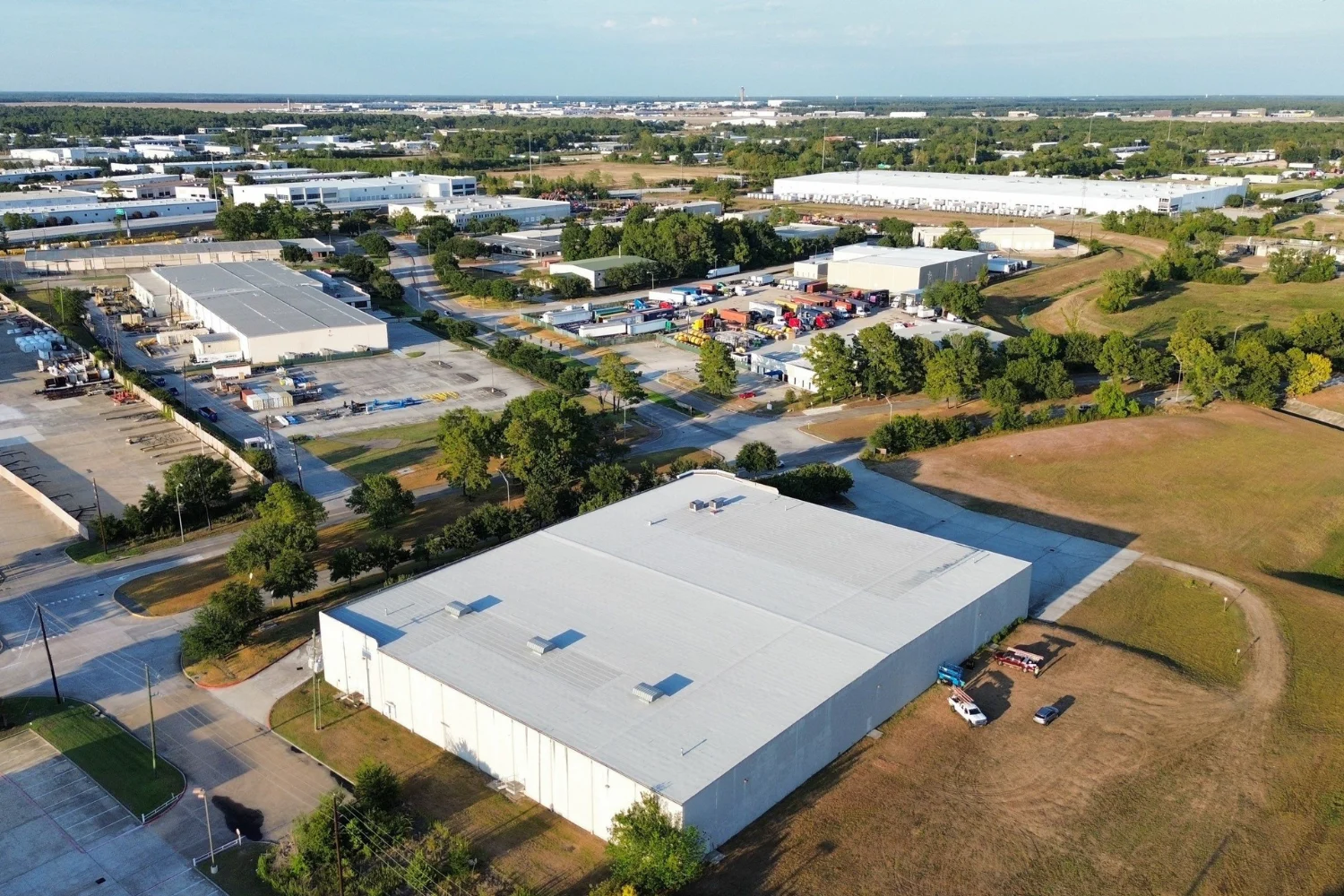
The Walmart Distribution Center on 40th Avenue South in Fargo, North Dakota is among the largest warehouse footprints in the region and operates year-round despite some of the most severe weather that any distribution facility in the United States routinely faces. Fargo's climate produces ground snow loads of forty pounds per square foot, sustained winter temperatures below minus twenty Fahrenheit that can last for days, spring snowmelt events that deliver the equivalent of months of precipitation in a matter of weeks, and summer hailstorms that routinely produce hailstones large enough to penetrate inadequately specified membranes. A roofing system for a Fargo warehouse must be engineered for all of these events simultaneously, not optimized for one while compromising on the others.
Drainage design for Fargo warehouses begins with a recognition that snowmelt, not rainfall, is the primary drainage event that governs system sizing. During a typical Red River Valley spring thaw, a large warehouse roof can accumulate snowmelt faster than any reasonable drain sizing would anticipate if the event is accompanied by rain. The North Dakota Building Code requires all commercial roofs to provide positive slope of at least one-quarter inch per foot to interior drains, which must be electrically heat-traced in the drain bowl and the first six feet of conductor pipe. Overflow scuppers through the parapet are mandatory under the NDBC and must be positioned two inches above the primary drain rim elevation. All scupper openings must also be heat-traced to prevent ice formation that would block overflow drainage during the critical thaw events.
Fully adhered EPDM is the dominant warehouse roofing membrane in the Fargo market for a straightforward reason: it retains flexibility at temperatures down to minus forty Fahrenheit, a threshold that no other single-ply membrane consistently matches. Sixty-mil reinforced EPDM, factory-seamed with factory tape rather than field-applied lap adhesives, eliminates the installation quality variability that occurs when field crews are applying contact adhesives in sub-optimal temperatures. Mechanically fastened TPO is used on some Fargo warehouse projects, but only when the contractor specifies a cold-climate formulation and has a heated-tent capability for seam welding in temperatures below the manufacturer's minimum welding threshold. Standard TPO formulations should not be installed when temperatures are forecast to drop below thirty degrees within the warranty period of the seam weld.
Dock penetrations in Fargo warehouses are subject to the differential movement created by sixty to eighty degrees of annual temperature cycling. A dock canopy anchor bolt that penetrates a parapet or roof deck in a building that sees 140-degree total temperature swings over a calendar year will move more than any rigid sealant detail can accommodate over a fifteen or twenty year service life. The correct approach uses flexible EPDM pitch sleeves at all penetrating elements that have structural connections to the dock canopy, silicone sealant rated to minus sixty Fahrenheit at all surface-exposed joints, and an annual inspection protocol that identifies sealant cracking or membrane tearing before it becomes an active leak. In Fargo's climate, an annual inspection timed for late August, after the summer UV season but before the freeze cycle begins, is the most productive schedule.
Forklift exhaust management at Fargo distribution warehouses is particularly important because the long winter heating season means propane forklift exhaust is contributing to indoor air quality as well as the roofing penetration inventory. The Walmart distribution center and similar large operations use electrically powered forklifts in many internal zones, but loading dock operations frequently still rely on propane equipment. Each propane exhaust vent must terminate at least twenty-four inches above the finished roofing surface with a hinged cap that closes when the exhaust fan is not running, preventing cold-weather backdrafting of exhaust gases that can occur when negative pressure inside the warm warehouse meets extremely cold outside air at the stack opening.
Snow load structural engineering is the most consequential roofing-related engineering issue for Fargo warehouses. The forty-pound-per-square-foot ground snow load from ASCE 7 translates to a roof design snow load that, after slope, thermal, and importance factor adjustments, still typically runs twenty-five to thirty-five pounds per square foot on a large flat distribution center roof. A 500,000-square-foot warehouse roof at full design snow load is carrying twelve to eighteen million pounds of snow. Any re-roofing project that adds polyisocyanurate insulation thickness must be preceded by a structural analysis confirming that the existing deck and framing can carry the combined dead load of the new assembly plus the full design snow load. North Dakota's building department has become more stringent about requiring these calculations since a series of roof collapses in the Fargo area during severe winters in recent decades.
Energy efficiency for Fargo warehouses is almost entirely a winter heating concern, since the brief North Dakota summer means cooling season constitutes only three to four months of the year. Above-deck polyisocyanurate insulation at R-30 to R-35 is the current energy code baseline for new warehouse construction in North Dakota, and the investment in high R-value insulation returns in heating cost savings over the first five to seven years of ownership. The critical specification detail is using a cold-temperature-rated polyiso facer on the lower course to maintain the effective R-value through Fargo's January cold snaps, where standard polyiso can lose thirty percent of its rated R-value due to the cold-temperature performance characteristic of isocyanurate foam.
Scheduling a Fargo warehouse re-roof is severely constrained by the short outdoor construction season. The membrane-compatible outdoor window is approximately May 15 through October 1, a period of less than five months. Within that window, the contractor must complete all tear-off, insulation installation, and membrane work, leaving the October to May period for ancillary work like parapet cap replacement and roof drain upgrade work that can be done independently of membrane installation. Large warehouse projects in the Fargo market are typically phased over two summer seasons to avoid rushing the installation quality that comes with aggressive single-season scheduling.
Choosing a roofing contractor for a Fargo distribution center requires verifying their familiarity with North Dakota's snow load requirements, their capacity for phased multi-season scheduling, and their access to cold-climate-rated membrane materials through regional supply chains. Contractors from warmer markets who enter the Fargo market for a single large project often underestimate the short season and the cold-weather installation requirements, and the resulting quality issues may not manifest until the second or third winter. Verify that the contractor has completed comparable projects in the FM 4 climate zone and that the manufacturer's warranty explicitly covers installations in North Dakota's climate without temperature-based exclusions.
- What roofing membrane is best for a warehouse in Fargo, ND?
- Fully adhered sixty-mil EPDM with factory-seamed lap splices is the most reliable choice for Fargo's extreme cold, retaining flexibility to minus forty Fahrenheit. Mechanically fastened TPO with a cold-climate formulation is an alternative but requires heated-tent capability for seam welding in sub-threshold temperatures.
- How are snow loads managed on Fargo warehouse roofs?
- North Dakota's forty-pound ground snow load translates to twenty-five to thirty-five pounds per square foot of design roof snow load. Any re-roofing project that adds insulation requires a structural analysis of combined dead and snow loads. Interior drains and all scupper openings must be electrically heat-traced to prevent ice blockage during spring thaw events.
- Why does polyisocyanurate insulation require special specification in Fargo?
- Standard polyiso loses up to thirty percent of its rated R-value at sustained minus-twenty Fahrenheit temperatures due to cold-temperature foam performance characteristics. Specify a cold-temperature-rated facer on the lower polyiso course to maintain effective R-value through Fargo's coldest winter periods.
- What is the construction season for warehouse roofing in Fargo?
- The membrane-compatible window is approximately May 15 through October 1, less than five months. Large projects are typically phased over two summer seasons to maintain installation quality. Ancillary work like parapet cap replacement can extend into early November.
- How should dock canopy penetrations be detailed in a building with Fargo's temperature cycling?
- Use flexible EPDM pitch sleeves at all structural dock canopy penetrations to accommodate sixty-to-eighty-degree annual temperature cycling. Apply silicone sealant rated to minus sixty Fahrenheit at surface-exposed joints. Schedule annual late-August inspections to catch sealant cracking or membrane tearing before the freeze cycle begins.
Questions Building Owners Ask
What usually changes the price for acrylic and silicone roof coatings?
For acrylic and silicone roof coatings, access, wet insulation, deck repair, edge metal, drains, temporary protection, after-hours work, and occupied-building staging change the number faster than the roof label. We verify those acrylic and silicone roof coatings conditions around Casselton before treating a square-foot price as reliable.
Can acrylic and silicone roof coatings be handled while the building is occupied?
Often, but the acrylic and silicone roof coatings sequence has to be planned. We review entrances, loading docks, patient or tenant areas, roof access, odor sensitivity, and weather windows near Veterans Boulevard Corridor before recommending daytime, phased, or after-hours work.
How do we know if acrylic and silicone roof coatings should be repair, coating, recover, or replacement?
We look at acrylic and silicone roof coatings through wet insulation, deck condition, attachment, slope, seam condition, drain performance, and edge-metal risk. If the roof around June normal precipitation of 4.29 inches is dry and stable for acrylic and silicone roof coatings, preservation options stay on the table. If moisture or deck damage is spreading through acrylic and silicone roof coatings, replacement planning becomes more defensible.
What documentation do we get after a acrylic and silicone roof coatings inspection?
Typical acrylic and silicone roof coatings documentation includes roof-area notes, photo locations, leak or damage observations, priority levels, repair limits, access constraints, and budget categories. On storm work tied to acrylic and silicone roof coatings, we provide contractor-side roof evidence without promising insurance outcomes.
How quickly can you look at acrylic and silicone roof coatings after a leak or storm?
Timing for acrylic and silicone roof coatings depends on weather, crew load, access, and whether interior water is active. We triage emergency conditions first, especially when water is entering occupied space near healthcare campus roofs, and then separate temporary dry-in from permanent scope.