
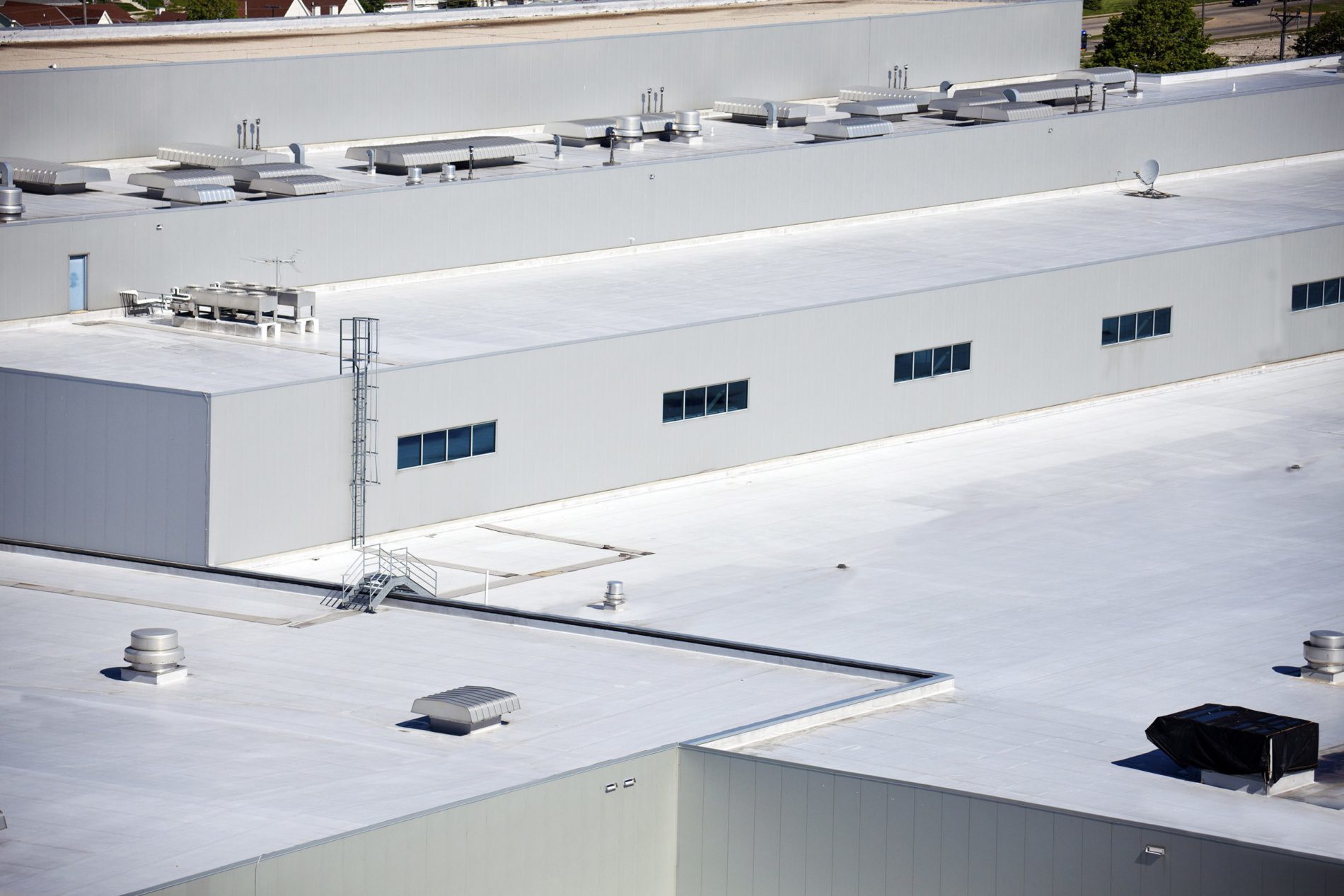
CNH Industrial's agricultural equipment manufacturing and distribution operations in Fargo, North Dakota sit at the center of one of the most agriculturally intensive regions in North America, and their roofing requirements are shaped by both the demanding climate of the Northern Plains and the specific chemical and physical environment of large-scale farm equipment production. The facilities that produce and distribute combines, tractors, and specialty equipment for the Red River Valley's grain and sugar beet operations handle cutting oils, hydraulic fluids, protective coatings, and heavy steel fabrication, all of which create chemical exposure conditions that must be evaluated carefully before any roofing material is specified for these buildings.
Fargo's climate is among the most extreme in the continental United States from a roofing perspective. The combination of ground snow loads that regularly exceed 40 pounds per square foot, winter temperatures that drop below minus 40°F, and summer heat that pushes above 100°F creates a thermal cycling range of 140°F or more between the coldest and warmest days of the year. No roofing material performs identically at both extremes, and the stress placed on seams, adhesives, and flashings by repeated cycling through this full range is the primary driver of premature roofing failure at agricultural equipment manufacturing facilities throughout the Fargo-Moorhead area.
Snow drift management is a structural and operational priority at large-span manufacturing buildings in Fargo. The Red River Valley is flat and open, which means that wind-driven snow can build enormous drifts at any vertical surface, parapet walls, rooftop equipment screens, and building projections all generate drift accumulation that can reach several times the ground snow load in concentrated areas. ASCE 7 snow drift provisions are engineering minimums, and Fargo-area structural engineers typically apply additional conservatism in their designs for manufacturing buildings because the cost of a structural failure is catastrophically higher than the cost of extra steel. Re-roofing projects at aging facilities should include a structural reassessment of drift-prone areas before new insulation, which adds dead load, is specified.
Agricultural chemical exposure is a unique risk factor at Fargo manufacturing facilities. Equipment destined for pesticide application, fertilizer handling, and grain storage is manufactured and tested with representative chemicals in some facilities, and even facilities that don't directly handle agricultural chemicals are exposed to crop-season airborne concentrations of ammonia, hydrogen sulfide from feedlot operations, and herbicide drift that can reach meaningful concentrations in the region during growing season. Roofing materials at these facilities should be tested for resistance to ammoniacal environments, and contractors should be aware that some membrane manufacturers have issued guidance specifically addressing agricultural chemical exposure that is worth reviewing for Fargo-area projects.
Heavy equipment fabrication vibration is a constant presence at Fargo's agricultural equipment manufacturing facilities. Plasma cutting tables, hydraulic press brakes, and large CNC machining centers all generate structural vibration that is transmitted through building frames to roof decks. In the extreme cold of North Dakota winters, roofing materials become more brittle and less able to accommodate micro-movement, which means that vibration-related fatigue cracking is most likely to initiate during the coldest months of the year. Fargo contractors serving manufacturing facilities specify low-temperature-rated membranes, products tested to retain flexibility at temperatures below minus 40°F, as a non-negotiable requirement for any manufacturing roof application in this climate.
Skylights in Fargo manufacturing buildings serve a different function than in warmer climates. In a region where winter daylighting hours are limited to less than nine per day at the winter solstice, maximizing natural light from skylights reduces both lighting energy costs and the psychological effects of working in artificially lit spaces for extended periods. However, the hail exposure in the Fargo area, severe hailstorms are a regular occurrence between May and September, requires impact-rated glazing for all skylight systems. Polycarbonate panels rated for large-hail impact are the standard specification for new skylight installations at North Dakota manufacturing facilities, and contractors who specify standard residential-grade polycarbonate panels routinely find them destroyed within one or two hail seasons.
Coordination with production schedules at Fargo agricultural equipment facilities is heavily influenced by the seasonal demand cycle for farm equipment. Pre-planting season demand peaks in March and April, driving maximum production from November through April, precisely the worst weather window for roofing work in North Dakota. Roofing contractors must either confine their work to the summer months, when both weather and production schedules are most cooperative, or develop capabilities for cold-weather roofing that include heated tents, low-temperature-rated materials, and modified installation procedures. Very few Fargo roofing contractors have invested in cold-weather manufacturing roofing capabilities, which means that summer project windows are heavily contested and advance planning is essential to secure contractor availability.
Energy efficiency is a compelling financial driver for manufacturing roof insulation upgrades in Fargo, where natural gas heating costs are a significant operating expense for large facilities running continuous production. Adding insulation from R-20 to R-35 in a re-roofing project can reduce annual heating costs at a large manufacturing building by $40,000 to $80,000 per year, producing simple paybacks of three to five years on the insulation upgrade cost alone. North Dakota's industrial energy efficiency programs, offered through Basin Electric Power Cooperative and Xcel Energy, provide additional incentives for qualifying insulation improvements that further reduce payback periods.
Long-term capital planning for manufacturing roofs in the Fargo area should account for the above-average rate of insulation moisture absorption that occurs in this climate due to vapor pressure differentials between the warm, humid interior of manufacturing buildings and the extremely cold, dry exterior air in winter. Infrared scanning and nuclear moisture detection during annual inspections can identify insulation wetting before it progresses to deck deterioration, allowing targeted repairs that avoid the cost of full replacement of insulation that still retains the majority of its R-value.
- What roofing membrane performs best in Fargo's extreme temperature range?
- EPDM membranes with a minimum thickness of 60 mils and a demonstrated low-temperature flexibility rating below minus 40°F are the preferred choice for Fargo manufacturing applications. Fully-adhered installations eliminate the fastener-point stress concentration that makes mechanically attached systems vulnerable to thermal fatigue cracking. TPO is also suitable but requires careful selection of a formulation specifically rated for extreme cold flexibility.
- How should Fargo manufacturing facilities handle snow load management on large flat roofs?
- Large flat roofs should have positive drainage designed to remove meltwater promptly as winter and spring melts occur, because refreezing of pooled melt water creates ice loads that can exceed design limits. Heated drain systems are common in Fargo and are cost-effective given the frequency of freeze-thaw events. Snow removal from heavily loaded roofs after major storms is sometimes necessary, and facilities should have a documented snow removal plan that specifies safe shoveling techniques that won't damage the membrane.
- What agricultural chemical exposures should Fargo roofing contractors test for?
- Ammonia from fertilizer operations, hydrogen sulfide from nearby confined animal feeding operations, and airborne herbicide compounds are the most significant agricultural chemical exposures in the Fargo area. Contractors should review the NRCA's guidance on agricultural building roofing and consult with membrane manufacturers' technical teams about product suitability for these specific chemical environments. Some manufacturers offer agricultural-application warranties that provide specific coverage for chemically exposed installations.
- How does hail exposure affect skylight selection for North Dakota manufacturing buildings?
- The Insurance Institute for Business and Home Safety (IBHS) rates roofing products including skylight glazing for hail resistance on a scale of 1 to 4. For the Fargo area, which experiences frequent large-hail events, a minimum UL 2218 Class 4 impact resistance rating or an equivalent IBHS Hail certification should be specified for all skylight glazing materials. This rating corresponds to resistance against 2-inch diameter hailstones and provides meaningful protection against typical North Dakota hail events.
- What energy efficiency programs are available for manufacturing roof insulation upgrades in Fargo?
- Basin Electric Power Cooperative's commercial and industrial efficiency program and Xcel Energy's commercial rebate program both offer incentives for commercial insulation upgrades that meet minimum threshold improvements. The specific rebate amounts and eligibility requirements change periodically, so facility managers should contact their utility provider directly or work with a contractor or energy consultant familiar with current program terms to determine the incentive available for a specific project.
Questions Building Owners Ask
What usually changes the price for acrylic and silicone roof coatings?
For acrylic and silicone roof coatings, access, wet insulation, deck repair, edge metal, drains, temporary protection, after-hours work, and occupied-building staging change the number faster than the roof label. We verify those acrylic and silicone roof coatings conditions around Casselton before treating a square-foot price as reliable.
Can acrylic and silicone roof coatings be handled while the building is occupied?
Often, but the acrylic and silicone roof coatings sequence has to be planned. We review entrances, loading docks, patient or tenant areas, roof access, odor sensitivity, and weather windows near Veterans Boulevard Corridor before recommending daytime, phased, or after-hours work.
How do we know if acrylic and silicone roof coatings should be repair, coating, recover, or replacement?
We look at acrylic and silicone roof coatings through wet insulation, deck condition, attachment, slope, seam condition, drain performance, and edge-metal risk. If the roof around June normal precipitation of 4.29 inches is dry and stable for acrylic and silicone roof coatings, preservation options stay on the table. If moisture or deck damage is spreading through acrylic and silicone roof coatings, replacement planning becomes more defensible.
What documentation do we get after a acrylic and silicone roof coatings inspection?
Typical acrylic and silicone roof coatings documentation includes roof-area notes, photo locations, leak or damage observations, priority levels, repair limits, access constraints, and budget categories. On storm work tied to acrylic and silicone roof coatings, we provide contractor-side roof evidence without promising insurance outcomes.
How quickly can you look at acrylic and silicone roof coatings after a leak or storm?
Timing for acrylic and silicone roof coatings depends on weather, crew load, access, and whether interior water is active. We triage emergency conditions first, especially when water is entering occupied space near healthcare campus roofs, and then separate temporary dry-in from permanent scope.